Choices and details about my ungor raiders
An interesting concept regarding the lowly beastmen—known as ungors in most Warhammer-like franchises—is that in these universes, no one likes them. Literally. Just like goblins or skaven slaves, they find themselves at the very bottom of their society’s hierarchy. These mutants are despised as much by their own kind—who have undergone even more mutations—as by members of so-called “civilized” factions less affected by corruption. Not beastly enough for the former. Too deformed to be civilized for the latter, who execute them at birth or abandon them in the forest. Yet they are the most numerous representatives of the beastmen—or “cloven-hoofs,” as they call themselves.
In terms of gameplay, the Ungors should be the most common units on the table in a beastmen army. In practice, this isn’t always the case, as the Gors (more heavily mutated specimens) claim this role, offering better cost-performance.
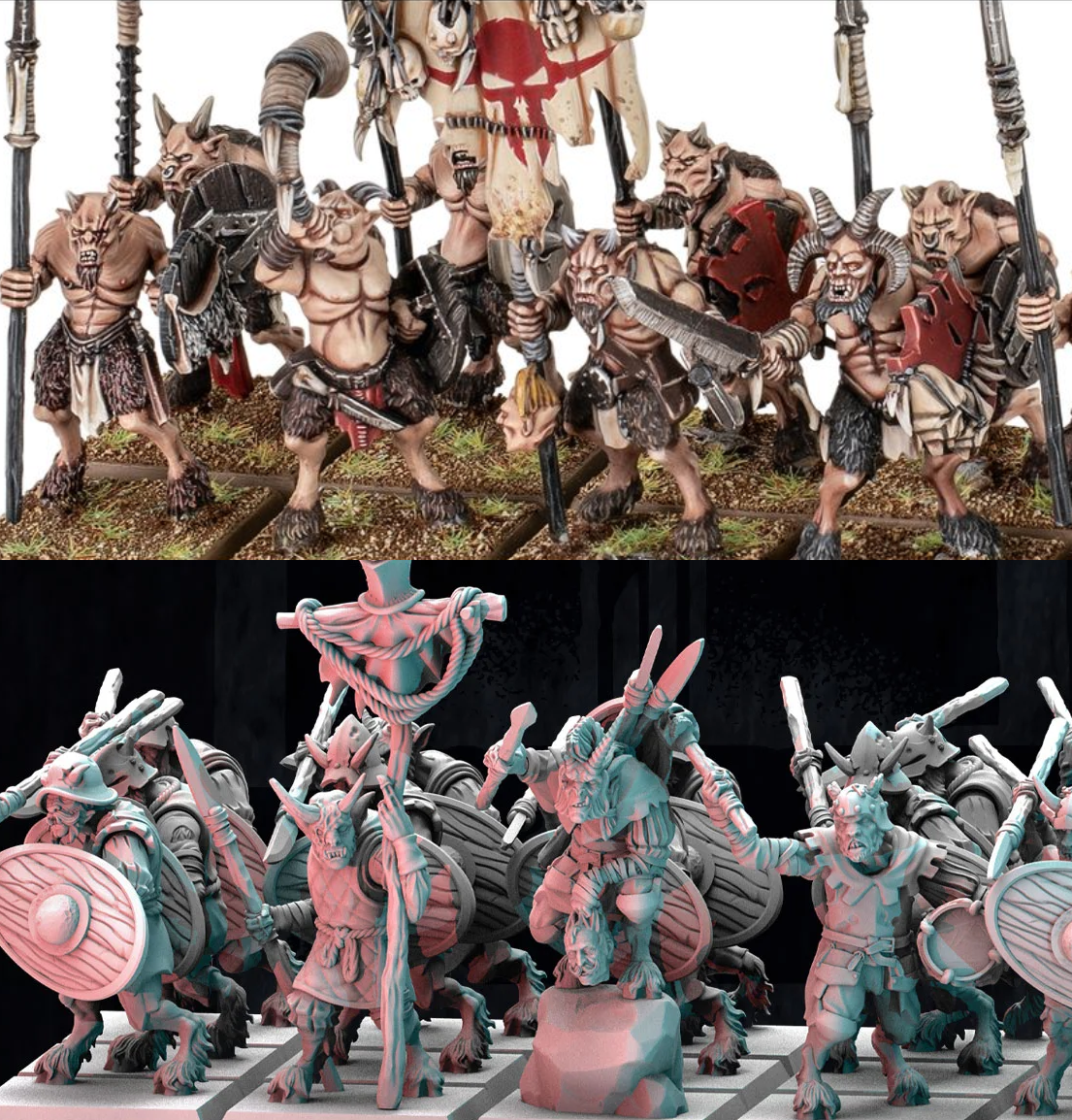
When it comes to collecting… it turns out that hobbyists don’t like Ungors either. And rightly so. Not only is a Gor physically much more interesting to assemble and paint, but Ungors are also usually ugly and lack variety. This is especially true with the models offered by Games Workshop (GW). Seriously, who would choose them after comparing these two images?
 |
While I don’t necessarily aspire to build an Ungor-based army myself—whether for gameplay or collecting (like everyone else, I prefer the Gors…)—I’ve come to enjoy aligning a few Ungor archers in tabletop games to harass the enemy and provide “easy points” that draw opposing units away from my more significant units. After all, making an enemy cavalry unit (which, roughly speaking, accounts for 10–15% of the enemy army’s cost) waste two game turns (or two-thirds of the game) chasing after my little Ungor archers (who account for a mere 5% of my army’s cost)—I’d call that a good deal. Plus, it’s a nice change from my undead army, which never flees, isn’t mobile, and can’t shoot. It’s a little pleasure I can’t resist. Not to mention that it gives me a chance to use a bit more color than I do with my main army.
There are two types of Ungor profiles: archer-skirmisher and infantry warrior. At GW, these are the same models with a simple weapon swap, while keeping the same torsos and heads. At Last Sword (LS), I’m lucky enough to have designs that are at least somewhat distinct. So, naturally, I started by focusing on the archer skirmisher.
With my models chosen, printed and assembled, here’s the initial direction I set for the painting:
- a muddy-brown color scheme to match my existing beastmen
- my signature green-grass-gravel bases (obviously)
- try not to mess up the skin, faces, and fur too much for once
- varying shades of weathered leather (using dusty, sandy, dark or orange tones to avoid a flat look), fur and rust, to really highlight the neglected appearance of the equipment
- touch of colors similar to my few Imperial troops
I wished to elaborate on this last point in particular. Indeed, I have a few imperial foot soldiers that I deliberately painted using the historical color schemes of various factions to represent soldiers from all corners of the empire, whose heraldry would be recognizable through those color schemes. And the designs of LS’s Ungors actually incorporate fragments of the baggy uniforms worn by the Landsknechts. What more could I ask for ?
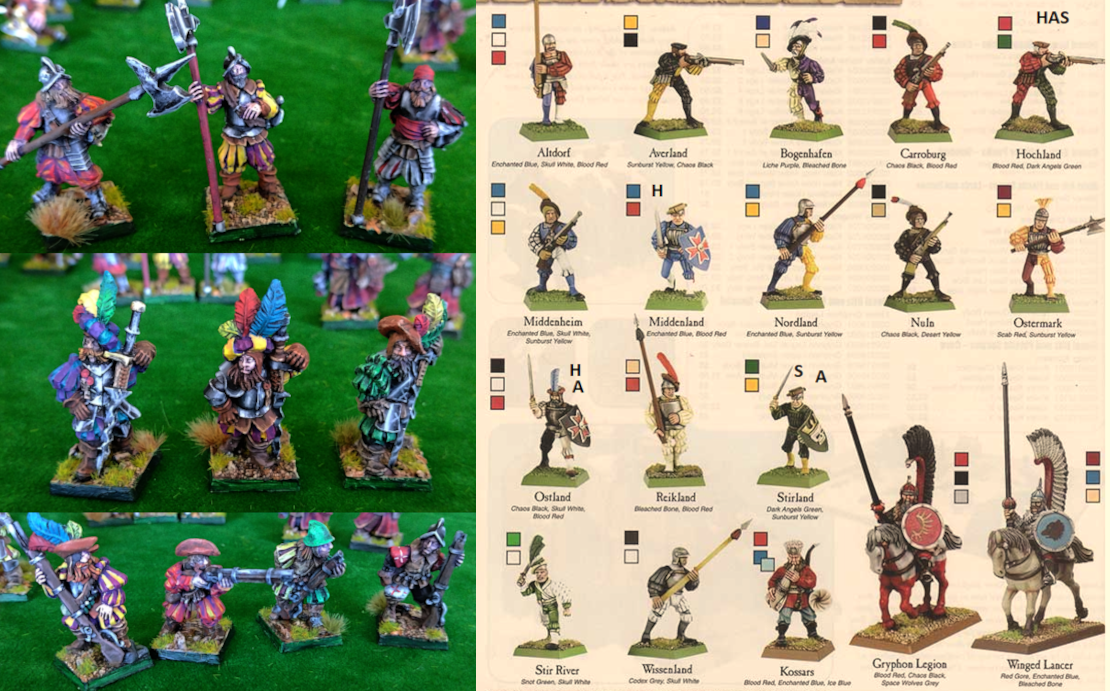 |
Except that here, we’re talking about Ungors, not Imperial troops. Technically, they’re mutants who have robbed the corpses of soldiers to take their gear. To reflect this, I focused on two aspects: dustier colors—even mud stains—and mismatched patches (unlike my Imperial models, which have vibrant colors and fabrics)
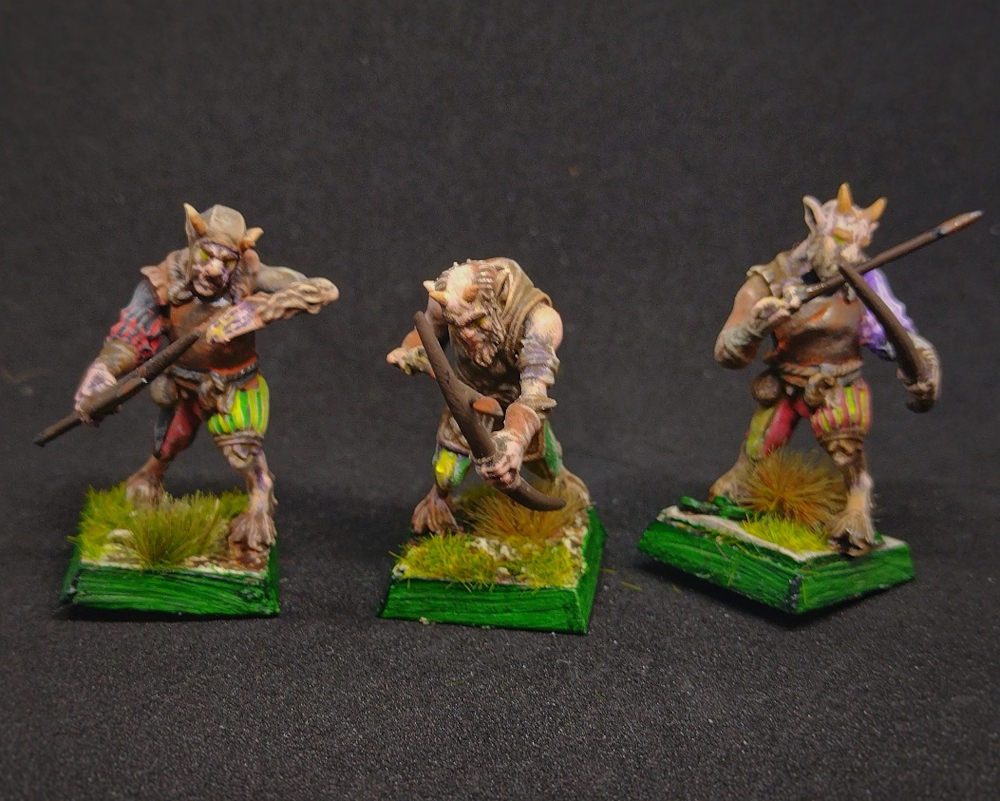
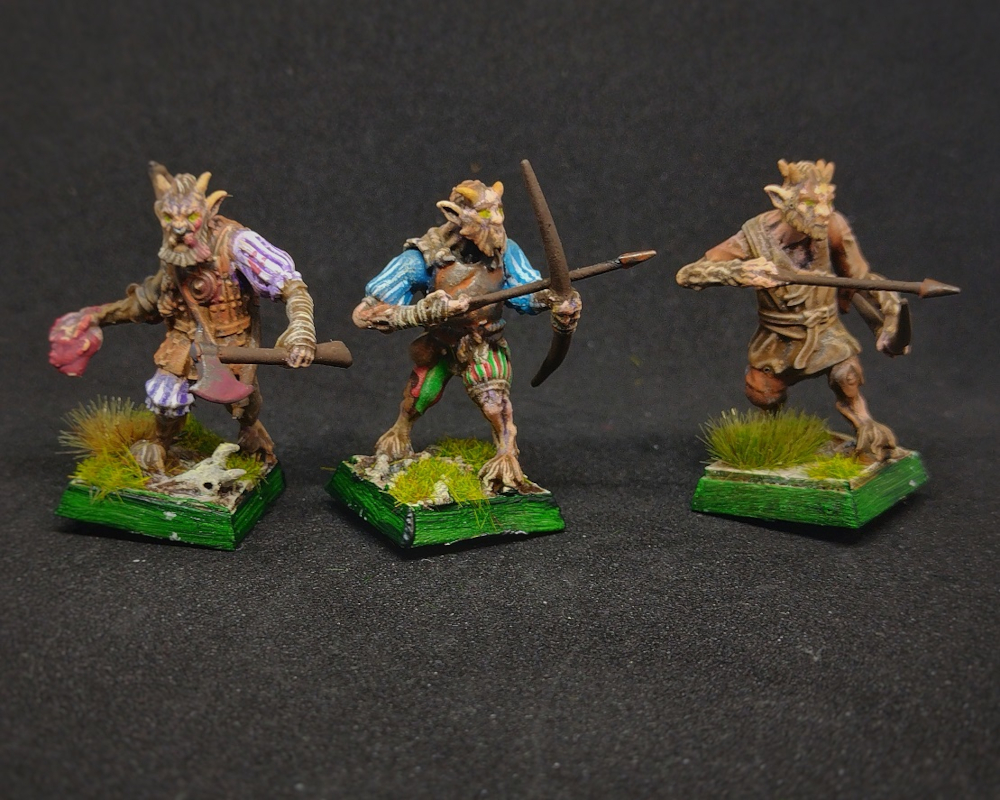
A few brushstrokes and some broken arrows later, there you go:
 |
 |
Detail des schemas
In these two examples, from left to right, we have:
- an archer wearing the colors of Carroburg and Stirland
- a second archer wearing only Stirland leggings
- a third archer wearing the colors of Ostermark and Bogenhafen
- the champion wearing only the colors of Bogenhafen
- the next archer wearing the colors of Ostermark and Middenheim
- the last archer wearing only shades of brown.
Unsurprisingly, my skin and faces are a disaster (and my photos, as always, a little blurry), buuuut overall I’m satisfied with them. Now I just have to see what my tabletop gaming buddies think when I throw darts at them, faced with the dilemma of pursuing a mediocre unit far from the heart of the battle or ignoring it and enduring it for the entire game.
More photos of these raiders in my gallery at this link